Mapping internal stellar cores in distant star-forming regions
Astronomers utilized high-resolution radio telescope data to map the internal structure of the distant star-forming region G40.282−0.219, revealing three distinct dense cores. This detailed breakdown clarifies how massive stars develop across different simultaneous phases of evolution.
Reviewed by Matheus Grangeiro
- Peer reviewed
- Yes
- Sample size
- 3
Key numbers
3cores
number of dense cores revealed in G40.282−0.219
3.4kpc
distance from Earth to G40.282−0.219
1.3mm
observational band used by ALMA
24.6solar masses
mass of core MM1
8.4solar masses
mass of core MM2
25km/s
velocity of silicon monoxide jet in MM2
5.2solar masses
mass of core MM3
6.7GHz
frequency of Class II methanol maser hosted by MM3
Press versus study
Omission
What the press says
The press text describes the masses of the cores explicitly: MM1 is about 24.6 solar masses, MM2 is about 8.4 M⊙, and MM3 is about 5.2 M⊙.
What the study shows
The provided abstract does not contain the specific numerical mass values (24.6, 8.4, and 5.2 solar masses) for the cores.
Evidence level: Observational astronomy; single-region ALMA analysis
Why it matters: Massive stars form in dense clumps of gas and dust that can contain several young stellar cores at different stages of development. Resolving those cores individually helps astronomers understand how stars of different masses mature within the same parental environment.
How ALMA observations expose hidden stellar cores A. G. Tegegne, a doctoral researcher at the Xinjiang Astronomical Observatory of the Chinese Academy of Sciences, led an analysis of the massive star-forming region G40.282−0.219 under the supervision of Jarken Esimbek and Andrey M. Sobolev. The team used ALMA observations at 1.3 mm to resolve the region, which lies approximately 3.4 kiloparsecs from Earth.
Millimetre and submillimetre observations can penetrate dense dust that obscures visible light. ALMA’s high angular resolution allowed the researchers to separate what earlier low-resolution observations had treated as a single massive young stellar object into three distinct dense cores: MM1, MM2 and MM3.
The study, published in The Astrophysical Journal as “Distinguishing between the Strongest Millimeter Compact Emission and Maser and Outflow Activities in the G40.282–0.219 Massive Young Stellar Object Cluster,” analysed the cores’ masses, densities, temperatures, molecular lines, outflows and masers.
Moving from unresolved clumps to individual cores Earlier low-resolution observations could measure the overall properties of massive dense clumps, but could not resolve individual dense cores or determine their physical and chemical properties.
The new ALMA data changed that picture by resolving three compact cores within the same parental clump. This demonstrates that a massive star-forming region may contain multiple young stellar objects with different masses and evolutionary stages.
The finding supports a broader point from recent ALMA research: massive dense clumps are often composed of several lower-mass dense cores rather than being monolithic structures.
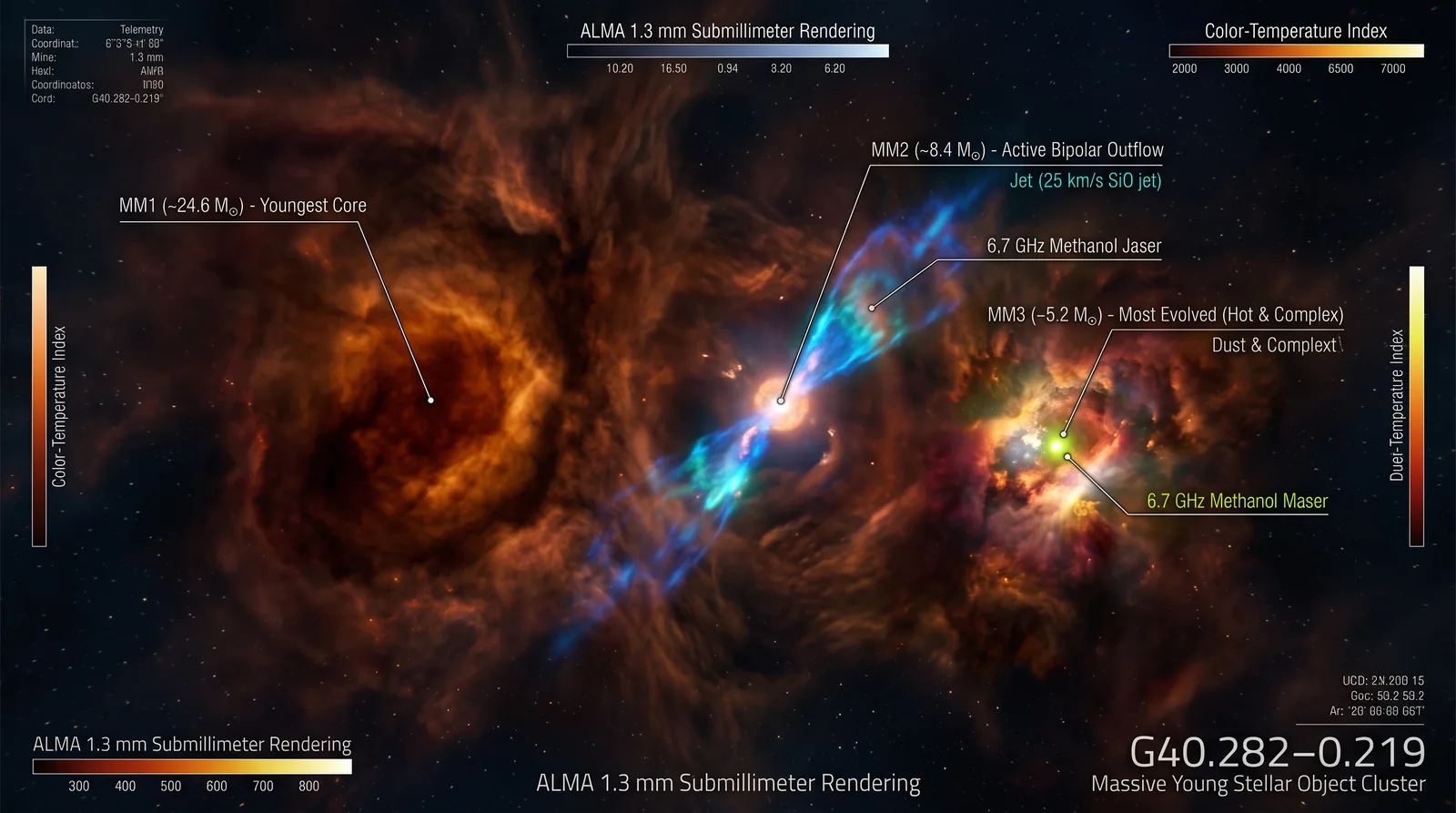
Physical properties and evolutionary sequence MM1 is the most massive core, at approximately 24.6 solar masses, but has the fewest detected molecular spectral lines. No outflows or masers were detected in association with it.
MM2 has an estimated mass of approximately 8.4 solar masses and drives a powerful outflow. Its silicon monoxide (SiO) jet reaches a velocity of about 25 km/s, indicating energetic activity around the young stellar object.
MM3 is the least massive core, at approximately 5.2 solar masses, but has the highest dust temperature and the richest molecular diversity. It also hosts a 6.7 GHz Class II methanol maser.
Taken together, these observations support an evolutionary sequence within G40.282−0.219: MM1 is the youngest core, MM2 is intermediate, and MM3 is the most evolved. The inference rests on multiple indicators—mass, density, temperature, molecular-line richness, outflows and maser activity—not on mass alone.
What the single-region study does not show The study establishes an evolutionary sequence within one massive star-forming region; it does not demonstrate that this sequence generalizes to all massive star-forming regions.
The reported masses are estimates based on the available observations, but the CAS release does not report their uncertainties or confidence intervals.
The absence of detected outflows or masers around MM1 does not prove that none exist; it means that none were detected under the observational conditions used.
The study does not test whether the three cores formed simultaneously, whether they will follow the same evolutionary path, or how their future masses and luminosities will evolve.
The available release does not report the detailed statistical analysis, observational setup or uncertainty propagation used to derive the physical parameters.
Verdict: ALMA observations at 1.3 mm resolved G40.282−0.219, approximately 3.4 kpc away, into three dense cores with estimated masses of 24.6, 8.4 and 5.2 solar masses. The evidence supports an evolutionary sequence from the youngest, most massive core, MM1, to the most evolved, least massive core, MM3; however, the uncertainties, detailed methods and broader generalizability are not provided in the available release.
Based on reporting from Chinese Academy of Sciences. This is an independent explainer, written in our own words with AI assistance; Chinese Academy of Sciences has not reviewed or endorsed it. Read the original for the full details.