How Urban Lifestyles Expand the Genetic Repertoire of Gut Bacteria
Researchers analyzed 5,981 isolate genomes from 56 donors across 9 countries to examine how modern lifestyle factors alter gut microorganisms. This matters because understanding these genetic shifts reveals how industrialization directly reshapes the human microbiome.
Reviewed by Matheus Grangeiro
- Peer reviewed
- Yes
- Sample size
- 5,981
Key numbers
8species
species showing statistically significant differences in protein-coding genes
80%
lower bound of horizontal gene transfer percentage
90%
upper bound of horizontal gene transfer percentage
1,841genomes
new genomes added to the Global Microbiome Conservancy collection
4,140samples
additional data samples used from the repository
5,981genomes
total isolate genomes evaluated
56donors
human donors providing the isolate genomes
9countries
geographic origins of the donors
Evidence level: Observation or measurement
Why it matters: The human gut microbiome is not static; it evolves in response to the ecological pressures its host environment imposes. Diet, pharmaceutical use, and hygiene practices characteristic of industrialized societies restructure the nutrient landscape and microbial neighborhood within the gut, creating selective conditions that bacteria — which can acquire genes laterally from neighbors within hours — are well positioned to exploit. Understanding whether and how industrial lifestyles imprint evolutionary signatures on gut bacterial genomes matters not only as a question in evolutionary biology, but because those signatures — genes encoding immune-recognized surface molecules, stress responses, and metabolic cofactor synthesis — have direct relevance to host health outcomes that remain largely unexplored.
How Modern Lifestyles Drive Genetic Expansion in Gut Microbes
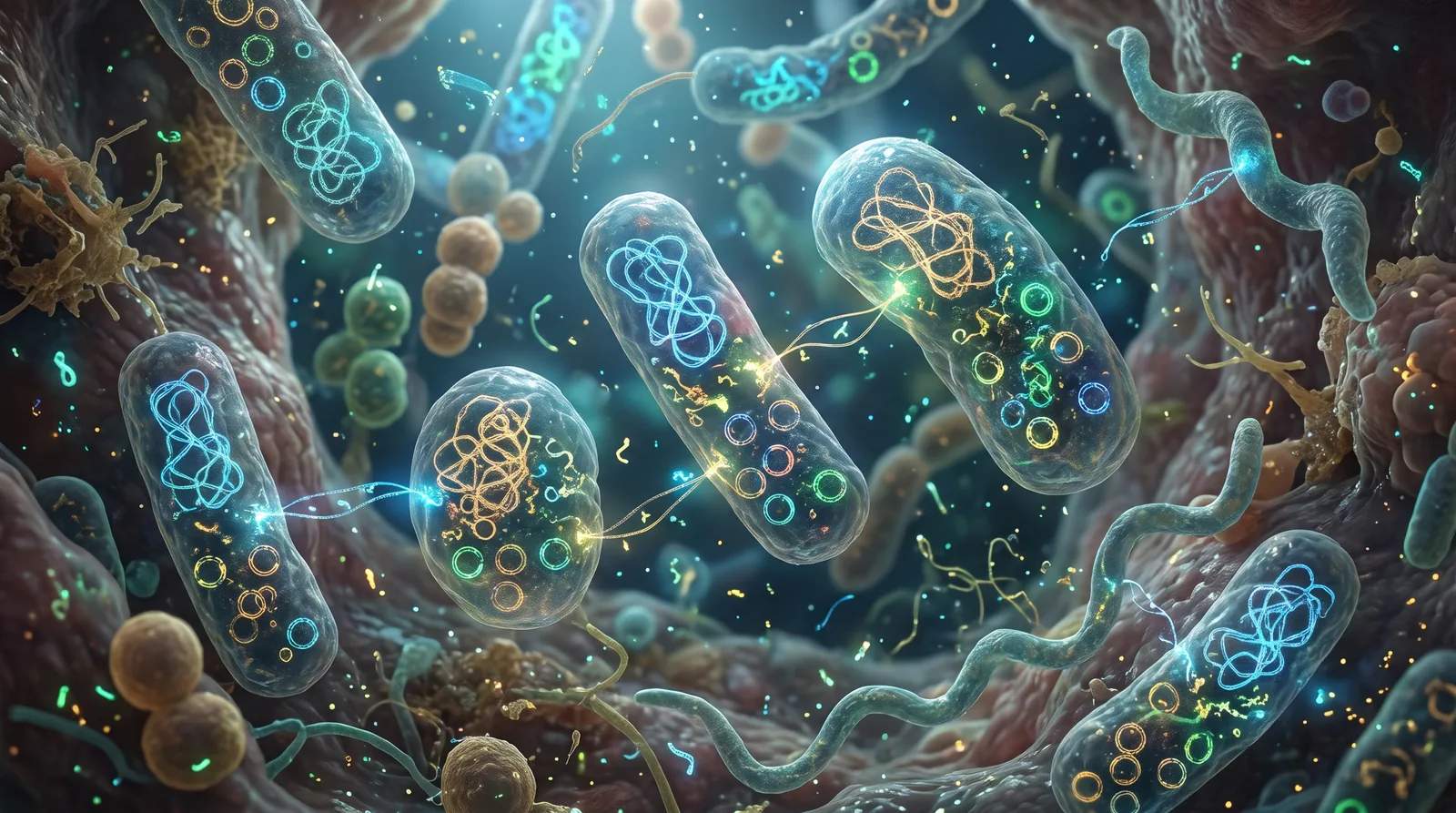
Szánthó and colleagues at the Okinawa Institute of Science and Technology, working in collaboration with the Global Microbiome Conservancy, applied phylogenetic reconciliation methods — originally developed to trace evolution across billions of years — to the comparatively recent question of how industrialization reshapes bacterial genomes on the timescale of human generations. Their central finding is a consistent pattern of proteome expansion and elevated genomic fluidity in gut bacteria isolated from industrialized hosts, driven by a recent acceleration in horizontal gene transfer (HGT). Rather than inheriting new functions from parent cells, these bacteria acquire them laterally from microbial neighbors, often packaged within mobile genetic elements such as plasmids and phages; between 80% and 90% of newly incorporated DNA segments arrived by this route.
The functional content of the acquired genes is not random. Across multiple bacterial species, selective enrichment appeared convergently in three categories: cellular envelope remodeling, central metabolism, and stress response. Among the specific genes identified were those encoding cobalamin (vitamin B12) biosynthesis pathways — relevant to the altered dietary B12 availability in industrialized diets — and those directing lipopolysaccharide production, a surface molecule the innate immune system uses to distinguish microbial identity. That industrialization-associated gene acquisition converges on these functions across phylogenetically distant species suggests not coincidental drift, but parallel adaptive pressure.
Analyzing Genomic Shifts Across Urban and Non-Urban Populations
The dataset underpinning these conclusions is unusually substantive for a study of this kind. The team added 1,841 high-quality isolate genomes to the Global Microbiome Conservancy repository and integrated a further 4,140 previously published genomes, yielding a total of 5,981 isolate genomes from 56 donors across 24 geographic locations in 9 countries. This collection was specifically designed to redress the well-documented overrepresentation of Western, industrialized populations in microbiome research; donors from non-industrialized settings — including communities without indoor plumbing, without consistent antibiotic exposure, and with subsistence-based diets — are explicitly included, making cross-lifestyle comparison possible in a way that standard clinical cohort data cannot support.
From this collection, ten species were selected for detailed comparative genomic analysis on the basis of adequate representation in both lifestyle settings. Eight of the ten demonstrated statistically significant increases in protein-coding gene counts among isolates from industrialized hosts; in all ten, genomes from urbanized donors were larger on average and more variable in gene content — a measure of pangenome fluidity — than their non-industrialized counterparts. The two-species exceptions underscore that the pattern, though broad, is not universal, and that taxon-specific ecological factors modulate the generalized industrialization signal.
What the Current Genomic Investigation Does Not Reveal
Three interpretive boundaries deserve explicit acknowledgment. First, the study identifies a robust association between industrialization and genomic expansion but cannot isolate which specific environmental driver — dietary composition, antibiotic exposure, reduced microbial transmission between individuals, or some combination — is causally responsible. Industrialization indexes a cluster of co-occurring changes rather than a single variable, and disentangling these effects would require longitudinal designs or controlled perturbation studies that observational genomics cannot provide.
Second, the functional significance of genome size increase is genuinely ambiguous. Larger genomes in bacteria are not automatically advantageous; in stable, resource-limited environments, maintaining unnecessary genes incurs metabolic cost, and purifying selection typically removes them. The observed expansion could reflect either positive selection for newly useful functions, or a relaxation of that purifying selection — a distinction with opposite implications for whether the changes represent adaptive response or genomic drift under reduced constraint.
Third, the analysis covers ten species, chosen for their representation across lifestyle groups; whether the convergent signals extend to the broader diversity of the human gut bacterial community, estimated to comprise hundreds of species, remains uncharacterized.
Misreadings
It may seem that all gut bacteria uniformly expand their genomes in response to urbanization. In fact: the study examined a selection of ten species, and statistically significant increases in protein-coding gene counts were detected in eight of them — not all, and not across the full taxonomic range of the human gut microbiome.
Verdict: Across 5,981 isolate genomes from nine countries, gut bacteria from industrialized populations carry significantly expanded genomes enriched for genes in cellular envelope remodeling, central metabolism, and stress response, with 80–90% of acquisitions arriving via horizontal gene transfer; the specific environmental drivers and clinical consequences of these changes remain to be established.
Based on reporting from OIST. This is an independent explainer, written in our own words with AI assistance; OIST has not reviewed or endorsed it. Read the original for the full details.